
Look out the window this time of year in Southern Oregon, and you are likely seeing plenty of gray skies and wet ground. February here is often defined by cool moisture and mud. For many folks, this weather signals a time to stay indoors and wait for the first real signs of spring. It feels like nature is dormant, so it is easy to assume that outdoor work should be paused too.
But if you own property around here, especially in Josephine County, you know that one thing is definitely not taking a break under that soggy soil: the Himalayan blackberry. These invasive vines are just biding their time, storing energy in massive root systems, waiting for the first few sunny days to explode into another season of growth. That is why, despite the mud on my boots, I consider February one of the most critical months of the year for property maintenance.
While it might seem counterintuitive to fire up heavy equipment when the ground is soft, these conditions are actually an agronomic ideal for mechanical removal. If you have been staring at an overgrown patch of briars debating when to tackle them, I am here to tell you that right now is the window of opportunity for effective blackberry root removal services.
Understanding The Rhizome Challenge
To understand why I prefer working in the winter mud, you have to understand how a blackberry plant operates. What you see above ground—the thick canes and nasty thorns—is just the tip of the iceberg. The real power of the plant lies underground in a complex network of roots called rhizomes.
These rhizomes are incredibly resilient. They store immense amounts of energy over the winter. When spring arrives, they use that stored energy to push new canes upward at an alarming rate. If you just mow over the top of a blackberry patch in the summer, you have not actually solved the problem. You have just given the plant a haircut. It will grow back, often thicker than before, because the root system is still intact and healthy.
The only way to truly set back a blackberry infestation is to remove that underground energy source. You have to get the rhizome out. And that is where the current weather conditions come into play.
Why Winter Soil Is Superior For Removal
Anyone who has tried to dig a hole in Southern Oregon during August knows exactly what our soil turns into. The summer heat bakes our heavy clay into something resembling concrete. If you try to pull a blackberry root out of dry summer soil, it will almost certainly snap off near the surface. The main root ball remains locked in the hard ground, ready to re-sprout.
In February, the situation is reversed. The cool moisture that has soaked the ground all winter makes the soil pliable and soft. When the soil is loose, it releases its grip on those deep root systems much more easily.
This is why mechanical weed control during winter is so effective. When I grab a large blackberry crown right now, the surrounding dirt gives way. Instead of snapping the root, I can often extract long sections of the rhizome intact. Every foot of root I pull out now is ten feet of thorny canes you won’t have to deal with in May. By getting the roots out before the clay hardens, we are doing permanent damage to the infestation rather than just managing its appearance.
The Right Tools For Blackberry Root Removal Services
You might be thinking that tackling a dense thicket of blackberries in the mud sounds like backbreaking work with a shovel. You would be right. Trying to do this by hand on anything larger than a small garden bed is nearly impossible and incredibly frustrating.
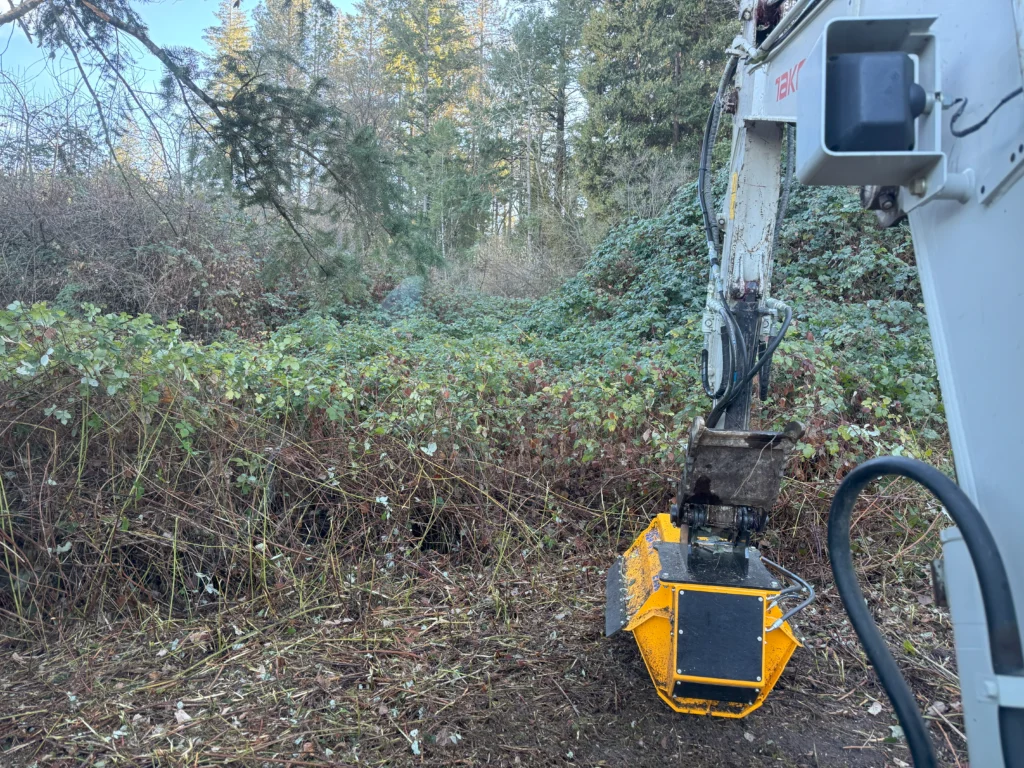
That is why I don’t use a shovel for these jobs. I use my Takeuchi TB240 excavator. This machine is practically built for the terrain and challenges we face around here. It has enough power to handle stubborn, entrenched root balls, but it is compact enough that I can maneuver it around trees and outbuildings without causing unnecessary damage to the surrounding property.
Because the soil is soft right now, that upward pull brings the root lattice up with it. I can shake the excess dirt off right there in the hole and pile the debris for later burning or chipping. It is a clean, efficient process that simply isn’t possible with a tractor loader or a bulldozer, which just push things around.
Tackling Invasive Brush Clearing In Josephine County
Very rarely do I find a property that only has blackberries. In Josephine County, neglected areas usually become a haven for a variety of unwanted guests. When I am hired for invasive brush clearing in Josephine County, I am usually dealing with a mix of blackberries, poison oak, Scotch broom, and sometimes overgrown manzanita.
The beauty of using the Takeuchi TB240 and a masticator attachment in February is that it handles this mixed bag perfectly. The same soft soil conditions that allow for blackberry root extraction also make it easier to pop out Scotch broom before it goes to seed.
Doing this work now also provides better visibility. With the deciduous leaves gone, I can see exactly what I am working on. I can identify the native madrone sapling hidden among the briars and work around it, ensuring we are only removing the plants you don’t want.
Get Ahead Of The Spring Rush
There is a tremendous sense of relief that comes with looking at a cleared piece of land in March, knowing it is ready for whatever plans you have, rather than dreading the impending battle with thorns. By addressing these issues while the soil is cooperative, you are saving yourself significant time and money down the road.
If you have a corner of your property that has been taken over by blackberries or other invasive brush, don’t wait until the ground is hard and the vines are growing a foot a day. Let’s take advantage of this February moisture. Give me a call at Dick Webster Mowing & More. I’ll come out, take a look at your situation, and we can discuss a plan to get those roots out of the ground for good.