
I’ve been working the land here in Southern Oregon for a long time. Every spring, I feel a sense of relief when the hills start to green up. It’s a beautiful sight after a long winter, and this year is no exception. The grass is growing, the wildflowers are starting to pop, and it feels like the threat of wildfire is a long way off. But. this year, that beautiful green carpet is hiding a serious problem.
We’ve just come through an unusually warm and dry winter. The snowpack in the mountains was lower than we’d like, and the soil just didn’t get the deep, sustained soaking it needs. While the recent spring rains have been welcome, they’ve mostly moistened the very top layer of the ground. This is enough to sprout the seasonal grasses, but it hasn’t done much for the deeper, woody fuels that have been drying out for months. That’s why I believe this Spring is a critical pivot point for every landowner in our community. Now is the time for fire fuel reduction in Southern Oregon, before the summer heat arrives and turns our beautiful landscape into a tinderbox.
A Warm Winter’s Legacy
It’s easy to look outside, see all the new growth, and feel a false sense of security. The problem isn’t the green grass; it’s the fuel that’s been accumulating for years. I’m talking about the dead and down branches from last year’s storms, the thickets of blackberry and manzanita that have grown unchecked, and the low-hanging limbs on our oak and pine trees. This is the material that carries a fire.
After a dry winter like the one we’ve had, this woody biomass is far drier than it would normally be at this time of year. Think of it like a stack of firewood that’s been left out to season all winter, but without the rain and snow to keep it damp. It’s ready to burn. The new green grass that’s growing up around and through it will eventually dry out, or cure, in the summer sun. When it does, it will act as a fast-burning fuse, igniting the heavier, hotter-burning woody fuels around it. This is why the work we do now is so important. We have a short window to get in and remove that underlying threat while the ground is still firm and the fire danger is relatively low.
Understanding The Fuel On Your Property
When I walk a property with a client, one of the first things I look for is what we call “ladder fuels.” It’s a simple concept that has huge implications for fire behavior. Imagine a fire starting on the ground, burning through dry grass. If it reaches a low-lying shrub, the flames will climb it. If that shrub is touching the low-hanging branches of a tree, the fire will use those branches like rungs on a ladder to climb right up into the tree’s canopy. Once a fire gets into the crowns of the trees, it becomes incredibly intense and almost impossible for firefighters to control from the ground.
Our goal with fire fuel reduction is to break that ladder. We do this by creating two types of space. First is vertical spacing—trimming the lower branches off of our larger, mature trees to create a gap of at least six to ten feet between the ground and the lowest limbs. Second is horizontal spacing—thinning out dense thickets of brush and smaller trees so they aren’t all clustered together. This separation helps prevent fire from easily jumping from one plant to another. It’s not about clear-cutting your land; it’s about thoughtful, selective clearing to interrupt a fire’s path.
Why Defensible Space Matters More Than Ever
This management of ladder fuels and spacing is the core principle behind creating defensible space. You’ve likely heard the term, and it’s a key recommendation from programs like Firewise USA. As one of the local defensible space clearing contractors, I see it as creating a buffer zone around your home that gives it a fighting chance to survive a wildfire. It gives our firefighters the safe space they need to work and can often be the single biggest factor in whether a home makes it or not.
The first thirty feet around your home is the most critical area. We focus on removing highly flammable vegetation. From thirty to one hundred feet out, we continue that process of thinning and creating that important horizontal and vertical spacing. The goal is to create a landscape that a fire will struggle to move through, causing it to drop from the crowns to the ground where it is slower and less intense.
My Approach To Surgical Land Clearing
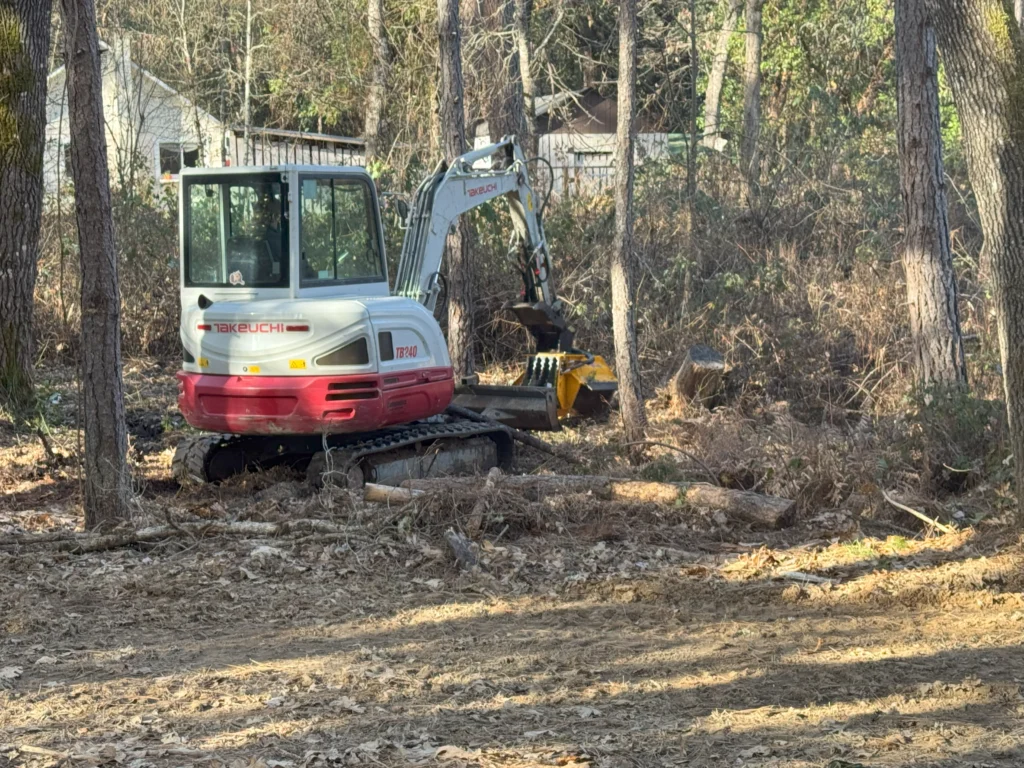
Over the years, I’ve learned that having the right tool for the job makes all the difference, especially when doing this kind of work. The older method often involved a big dozer that, while effective at clearing, could also cause a lot of damage to the soil and the very trees we’re trying to protect. That’s why I’ve invested in modern, specialized equipment for what I call “surgical clearing.”
I use a compact excavator on tracks that has a very light footprint on the land, minimizing soil compaction. At the end of its arm, I can attach different tools, like a powerful masticating head that mulches brush right where it stands. This precision allows me to go into a property and selectively remove only the problem fuels. We can thin a dense stand of trees, clear out invasive blackberry bushes, and remove ladder fuels without disturbing the character of your property. It’s a much more thoughtful and less disruptive way to achieve our fire safety goals.
Creating Firebreaks On Private Land
For larger properties, another key strategy is creating firebreaks on private land. A firebreak is a wider, strategically placed strip of land where we’ve cleared away most of the flammable vegetation. It’s not a dirt line down to bare soil, but rather a managed fuel break. We can place these along property lines, roads, or around important structures like a barn or well house. The purpose of a firebreak isn’t necessarily to stop a wildfire completely on its own, but to give firefighters a safe and accessible line from which to fight the fire. It slows the fire’s advance and reduces its intensity, giving them a place to make a stand.
Let’s Get Your Property Ready
I know this is a lot to think about, and it can feel overwhelming. But the time to act is now, while things are still green. The work we do in April lays the foundation for a much safer summer and fall. Waiting until the fire danger is high is simply too late.
If you have questions about fire fuel reduction on your Southern Oregon property, or if you’d just like a second set of eyes to walk your land with you, please give me a call. I’m your neighbor, and I’m here to help. I would be happy to come out, take a look at your specific situation, and talk about a plan that makes sense for you, with no obligation. Let’s work together to protect our homes and our beautiful community.