August in Southern Oregon has a distinct feel. The lush green of spring is a distant memory, and the Rogue Valley floor is thoroughly baked. Our pastures are yellow, the air is often thick with the smell of dust, and landowners across the region are keeping a watchful eye on the daily fire reports. During these hot, dry weeks, fire safety is the only thing that matters. But August also brings a very specific, limited opportunity for proactive landowners: those steep, north-facing slopes and deep ravines that are usually too wet, slick, or muddy to access are finally dry enough to clear.
Managing these hard-to-reach areas is a critical part of protecting your property from wildfire, but it requires a careful balance. Working in these conditions means navigating extreme fire danger levels, strict local regulations, and steep terrain that would roll a standard tractor. Over the years, I have learned that successful steep slope brush mowing in Oregon during the late summer is all about patience, the right machinery, and an absolute commitment to safety.
Operating Safely Under Extreme Fire Danger
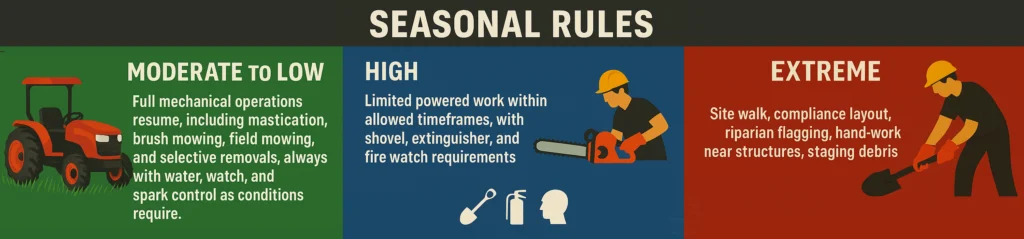
When the Oregon Department of Forestry declares an extreme fire danger level, the rules of the woods change for everyone. For homeowners, these regulations often mean a complete ban on using spark-emitting power tools, including lawnmowers and chainsaws, after 10:00 AM. In some areas, the use of this equipment is shut down entirely during the hottest weeks of the year. These rules are in place for a good reason; one strike of a steel blade against a hidden river rock can easily spark a wildfire that threatens our entire community.
As a professional contractor, I operate under a different set of strict industrial fire precaution levels, but the responsibility is even higher. I do not take chances with your property or my own safety. When I am out doing brush clearing in August, I work with a dedicated fire suppression kit on hand. This includes a commercial grade fire extinguisher, a shovel, and an active water supply ready to extinguish any potential spark instantly. Furthermore, I strictly adhere to required fire watch periods. After the machinery shuts down, I stay on-site for at least an hour, sometimes longer depending on the weather conditions, to monitor the work area and ensure that absolutely no hot spots exist. If the humidity drops too low or the afternoon winds begin to howl through the valley, we pack up and wait for safer conditions. No clearing job is worth the risk of a fire.
Why I Rely on a Tracked Midi Excavator
Many landowners ask me why they cannot just hire someone with a standard farm tractor and a tow-behind brush hog to clear their hillsides. The simple answer is safety and capability. Standard wheeled utility tractors are fantastic tools for flat pastures, but they are incredibly dangerous on steep inclines. A tractor has a high center of gravity. When you attempt to drive one across a steep slope, the risk of a rollover is incredibly high. Even driving straight up and down can lead to a loss of traction on dry pine needles, causing the machine to slide out of control.
To solve this problem, I do not use wheeled tractors on dangerous grades. Instead, I rely on a specialized four-ton tracked midi-excavator equipped with a high-performance rotary brush-cutting head. This machine is built for this exact type of rugged work. The wide rubber tracks distribute the machine’s weight evenly, providing incredible traction without tearing up the underlying soil structure. Because the tracks grip the ground so well, the machine remains exceptionally stable on slopes that would make a tractor driver slide down the hill.
The real beauty of this setup is the reach. Instead of having to drive over every single square foot of brush, I can position the excavator on a stable, flat bench or along the top ridge of a ditch. From there, I can extend the long, articulated boom down into the thickest brush. The cutting head shreds blackberry vines, manzanita, and oak scrub safely from a distance, keeping the heavy machine on secure ground while doing the heavy lifting down in the draw.
The Role of Hillside Vegetation Management
In our part of the state, hillside vegetation management is not about scraping the earth bare. If you remove every bit of plant life from a steep Southern Oregon hillside, you will have a clean slope in August, but you will face devastating mudslides and soil erosion when the winter rains arrive in November. The goal of responsible land clearing is to create a healthy, fire-resistant landscape.
When I tackle a hillside, I focus on removing what fire fighters call ladder fuels. These are the low-growing, highly flammable plants like Himalayan blackberry, invasive scotch broom, and dead manzanita that allow a ground fire to climb up into the canopy of our mature madrone, pine, and oak trees. By clearing out this thick underbrush, we break the chain of fuel. If a fire does enter the property, it stays low to the ground where it is much easier to manage, rather than crowning out in the treetops. We leave the deep, healthy root systems of the larger trees and native grasses intact to hold the hillside together when the seasons change.
Precision Excavator Land Clearing on Slopes
Using a tracked excavator allows for a level of precision that you simply cannot get with other land clearing methods. When performing excavator land clearing on slopes, I can selectively target invasive species and overgrown brush while leaving desirable native plants untouched. If there is a beautiful, healthy young oak tree growing in the middle of a blackberry patch, I can work the cutting head carefully around it, saving the tree while removing the competition.
Additionally, the rotary cutting head mulches the material as it cuts. Instead of leaving behind large piles of highly flammable brush that would need to be burned later in the winter, the machine shreds the vegetation into a fine mulch that is distributed evenly across the slope. This mulch layer serves several purposes during the dry summer months. It covers the bare soil, helping to retain what little moisture is left in the ground. It also acts as an immediate erosion control barrier, protecting the slope from heavy rain until native grasses have a chance to regrow in the spring. It is a clean, efficient process that leaves your land looking tended and cared for.
Working Together to Protect Our Valley
As a neighbor here in the Rogue Valley, I know how stressful the late summer months can be. We all want to do our part to make our properties safer, but doing the work ourselves during extreme fire danger can be daunting and dangerous. If you have steep slopes, overgrown ditches, or dense thickets of brush that are keeping you up at night, you do not have to tackle them alone.
Taking care of our hillsides is a community effort. If you would like to discuss how we can safely manage the vegetation on your property, give me a call. I would be glad to come out, take a look at your land, and talk about a plan to get your slopes cleared safely, efficiently, and in full compliance with our local fire regulations.